

1
/
of
4
MicroJPM
DIY FM Radio Electronic Soldering Kit - (AD30417)
DIY FM Radio Electronic Soldering Kit - (AD30417)
Regular price
$19.95 USD
Regular price
Sale price
$19.95 USD
Quantity
Couldn't load pickup availability
Description:
This is a dual-channel (87MHz - 108MHz) FM radio soldering electronic kit, based on the RDA5807 IC, ideal for students and beginners.
This 3.0V FM radio kit (RDA5807) is an 87 MHz to 108 MHz FM radio receiver. It is a simple receiver that works worldwide with two AA batteries. It is ideal for learning about electronic circuits, practicing and honing soldering skills, and expanding knowledge and interest in electronics.
Features:
- Universal frequency: 87 MHz-108 MHz
- Simple and perfect circuit
- DIY soldering manual
- Stable mounting bracket
- Supports battery charging
Parameters:
- Operating voltage: 3.0 VDC
- Power type: 2 AA batteries (not included)
- Channels: Dual channel
- Frequency precision: 0.1 MHz
- Equivalent noise: ≥30 dB
- Operating temperature: -25 °C to 85 °C
- Operating humidity: 5%~95% RH
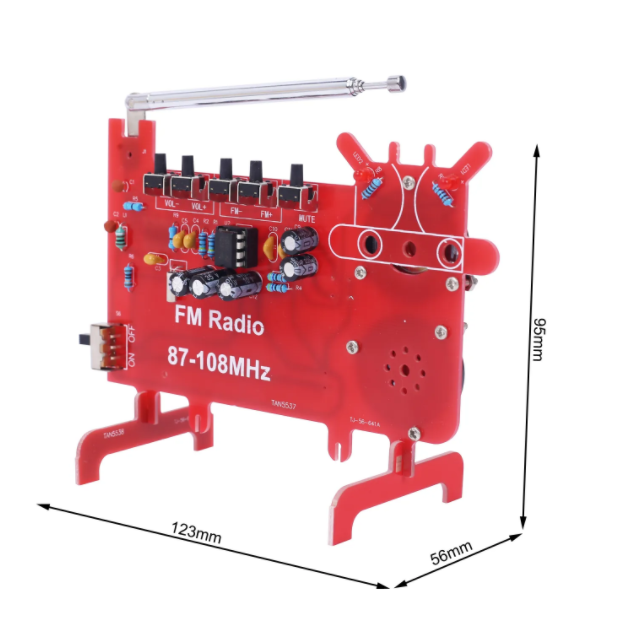
- Dimensions (installed): 123 x 95 x 56 mm
Functions:
- VOL- and VOL+ buttons are used to adjust the volume
- FM- and FM+ buttons are used to switch FM radio stations
- The side switch is the power switch
Applications:
- Soldering training
- School use
- DIY projects
- Project design
- Electronics competitions
- Gifts
- Craft collection
- Home decoration
- Souvenir collection
- Graduation projects
- Holiday gifts
Installation tips:
- The user must prepare the soldering tools:
- Small screwdriver
- Small wire cutters
- Fine-tip soldering iron (using a fine tip is recommended)
- Good quality thin-gauge solder (no larger than 1.0 mm is recommended)
- Magnifying glass
- Be patient until the installation is complete
- The package is an assembly kit. The user must complete the installation
- Do not keep the soldering iron in contact with components for a long time (1 second), as it could damage them
- It is recommended to start the project with the shortest components and continue with the taller ones. This is a common practice, as it makes it easier to hold the lower components to the board during soldering
- Pay attention to the polarity of the components
- Short-circuiting is strictly prohibited
- The user must install the LEDs following the instructions. Otherwise, some LEDs will not light up
- Install the complex components first
- Make sure all components are in the correct direction and position
- Check that all LEDs light up
- It is recommended to read the installation manual before starting!
- Use anti-static gloves or anti-static wrist straps when installing electronic components
Share
No reviews